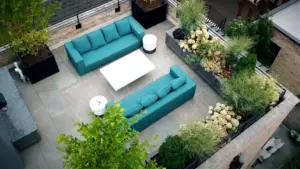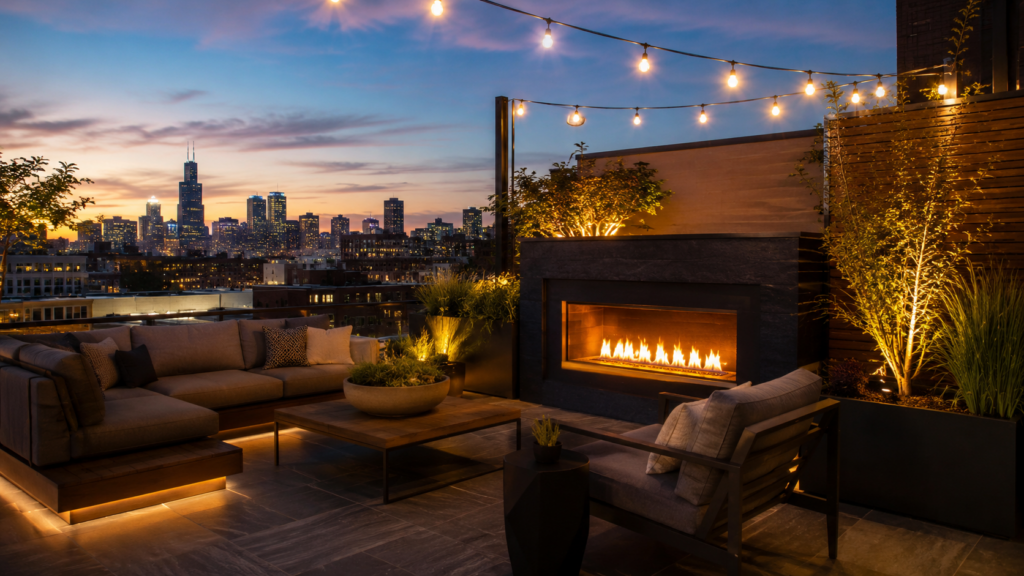
A roof deck can look beautifully finished during the day and still feel underdesigned after sunset. The difference is rarely furniture alone. The most successful roof deck lighting ideas shape how the space feels at night – relaxed, refined, welcoming, and safe enough to move through comfortably without flooding the deck in harsh brightness.
In Chicago, that matters even more. Urban rooftops compete with surrounding city light, shifting views, wind exposure, and changing seasons. Lighting has to do more than decorate. It needs to define dining areas, support circulation, soften architectural edges, and make the entire rooftop feel intentional from every angle.
What makes roof deck lighting work
On a premium rooftop, lighting should feel integrated rather than added on at the end. A single overhead fixture or a few portable lamps rarely solve the real design challenge. Roof decks are layered spaces. You may have lounge seating in one zone, dining in another, a grill area, planters, privacy screens, and stairs connecting multiple levels. Each of those elements benefits from its own type of light.
The goal is balance. Too little light and the deck feels unfinished or awkward to use. Too much light and you lose warmth, privacy, and the evening atmosphere that makes rooftop living so appealing in the first place. The best results come from a combination of ambient light, task light, and accent light, all scaled to the architecture and the way you actually use the space.
Roof deck lighting ideas for a more polished rooftop
1. Start with low-level perimeter lighting
Perimeter lighting is one of the strongest foundations for a rooftop plan because it defines the edges of the space without overwhelming the eye. This might be built into bench seating, low walls, railing-adjacent details, or custom planters. The effect is subtle, but it gives the deck structure after dark and helps the rooftop feel larger and more composed.
This approach is especially effective in urban settings where you do not want lighting competing with skyline views. Instead of drawing attention to the fixture, it creates a quiet glow that supports the architecture.
2. Use step lighting anywhere the elevation changes
If your deck includes stairs, split levels, or transitions between entertaining zones, step lighting should not be treated as optional. It is one of the most practical upgrades you can make, and it can be highly elegant when integrated correctly.
Recessed stair lights and under-cap lighting keep pathways legible without adding visual clutter. On rooftops, where evening entertaining often continues long after sunset, this is a safety decision as much as a design one.
3. Add dining light that feels intimate, not commercial
Outdoor dining areas need enough illumination to make meals comfortable, but they should never feel like a restaurant patio under utility fixtures. A well-scaled pendant, overhead string configuration, or carefully placed sconces can create a sense of occasion while keeping the atmosphere soft.
The right solution depends on the structure. If there is a pergola or covered area, suspended fixtures may work beautifully. If the deck is open to the sky, portable rechargeable fixtures or integrated lighting in nearby planters and screens can support the table without requiring a heavy overhead element.
4. Build lighting into planters
Planters do more than hold greenery on a rooftop. They often define circulation, create privacy, and frame seating areas. When lighting is incorporated into planter walls or placed carefully among plantings, the result is a more dimensional nighttime environment.
This works particularly well with ornamental grasses, small trees, and layered plant palettes that catch light and shadow. The key is restraint. You want the planting to read as texture and silhouette, not as a spotlighted display unless there is a specific focal point you want to feature.
5. Highlight architectural screens and vertical features
Privacy screens, fencing details, outdoor fireplaces, and built-in bars all present opportunities for accent lighting. These vertical features can anchor the composition at night, especially on a roof deck where much of the furniture sits low and sightlines extend outward.
A gentle wash of light on a textured wall or screen adds depth and sophistication. It also helps the deck feel finished from inside the home, which matters more than many homeowners expect. A well-lit rooftop should look exceptional both when you are standing on it and when you are viewing it through interior windows.
6. Use under-seat lighting for lounge areas
Built-in benches are common on city rooftops because they save space and create a custom look. Adding concealed lighting beneath the seat line gives those installations a floating effect and introduces just enough ambient light for conversation areas.
This is one of the most effective ways to make a lounge zone feel high-end without relying on visible decorative fixtures. It is also useful when you want a warm social atmosphere but prefer to keep overhead lighting to a minimum.
7. Keep task lighting focused at the grill and bar
One common mistake is lighting the entire deck brightly because one area needs more function. Grill stations, prep counters, and outdoor bars do need stronger task lighting, but that brightness should stay targeted.
Concentrating higher-output light in cooking and service areas allows dining and lounging spaces to remain softer. That contrast makes the roof deck more comfortable overall. It also helps the entertaining experience feel more layered and intentional instead of uniformly bright.
8. Consider portable decorative fixtures as a finishing layer
Not every lighting element has to be permanently built in. Portable lanterns, cordless table lamps, and rechargeable accent fixtures can add flexibility and personality, particularly if you entertain in different ways throughout the season.
These pieces should not carry the entire lighting plan, but they can complete it. They work best as finishing touches once the architectural and circulation lighting is already handled.
9. Respect the skyline and neighboring properties
A rooftop has a different relationship to light than a backyard. On many Chicago properties, you are elevated above alleyways, near neighboring terraces, and fully visible from surrounding buildings. That makes glare control and fixture direction especially important.
Downlighting, shielding, and concealed sources are often better choices than exposed bulbs or upward-facing fixtures. The objective is to create atmosphere on your deck without pushing unwanted light into nearby sightlines. Good rooftop lighting is generous to the user and disciplined in how it travels.
10. Put everything on separate controls
This may be the least glamorous idea on the list, but it is often the difference between a good lighting plan and a truly usable one. Dining light, perimeter lighting, step lights, and accent lighting should not all be tied to a single switch.
Separate controls let you adapt the mood for a quiet evening, a larger party, or late-night cleanup. Dimming adds even more flexibility. For custom projects, thoughtful control planning is part of the design, not just an electrical detail.
Design choices that matter more on a Chicago roof deck
Not every roof deck lighting idea translates equally well to an urban rooftop. Wind exposure can affect decorative fixtures and flames. Seasonal weather can influence material durability and fixture performance. Reflections from adjacent buildings and interior glass can make overly bright lighting feel sharper than expected.
That is why fixture placement, color temperature, and construction coordination matter so much. Warm light usually feels best in residential entertaining spaces, but the exact tone should complement hardscape materials, planting, and the architecture of the home. Likewise, integrated lighting details often need to be considered early, especially when they are being built into masonry, carpentry, pergolas, or custom containers.
This is also where a design-build approach has real value. Lighting on a rooftop is not just a decorating decision. It intersects with layout planning, electrical routing, drainage conditions, structural limitations, and how the entire outdoor environment is constructed. For high-end urban properties, those details shape the final experience.
The difference between more light and better light
Many homeowners start by asking how to make the deck brighter. The more useful question is how to make it feel better at night. Better light supports conversation, flatters materials, improves safety, and gives each zone a clear purpose.
Sometimes that means less light than expected. A lounge area may benefit from a very soft glow, while steps and cooking surfaces require stronger definition. Sometimes it means hiding the source entirely so the effect feels effortless. And sometimes it means designing the rooftop lighting plan alongside the planting, built-ins, and hardscape so every element works together from the beginning.
For homeowners investing in a custom rooftop, lighting should never be the last decision. It is one of the finishing layers that makes the space feel complete, livable, and distinctly personal. Botanical Concepts Chicago approaches rooftop environments with that larger perspective – where architecture, comfort, and craftsmanship all have to meet.
If you are considering roof deck lighting ideas for a new project or an existing space that feels flat after dark, start by thinking less about fixtures and more about experience. The right evening atmosphere is usually built one layer at a time, with enough precision that the whole deck feels effortless when the sun goes down.