A rooftop deck design can look finished on paper and still feel exposed in real life. The difference is often the planter strategy. The best planters for roof decks do more than hold soil – they shape views, create privacy, soften architecture, and make a hard urban surface feel like a true outdoor room.
On a Chicago rooftop, planter selection is not just a style choice. Weight limits, wind exposure, drainage, freeze-thaw cycles, and access all matter. A planter that looks perfect in a showroom can become a problem quickly if it is too heavy, too shallow, poorly drained, or out of scale with the space. That is why the right answer is usually not one planter, but the right combination of planter material, size, placement, and planting design.
What makes the best planters for roof decks?
The strongest roof deck planter choices balance performance and aesthetics. They need to be durable enough for harsh rooftop conditions, refined enough to complement the architecture, and practical enough to support healthy plant growth.
Weight is usually the first filter. Unlike a ground-level garden, a roof deck has structural limits that should guide every design decision. That does not mean a rooftop has to feel sparse or overly cautious. It means the planter system needs to be selected with the structure in mind, especially after adding saturated soil, mature plant material, irrigation, and seasonal weather conditions.
Wind is the second major factor. Many rooftops experience stronger and more consistent wind than clients expect, even when the deck feels comfortable at seating level. Lightweight pots that are ideal on a patio may be too unstable on a roof. Taller plantings may also need deeper, wider containers to anchor roots and prevent stress.
Then there is drainage. Roof decks need planters that release excess water efficiently without creating staining, pooling, or membrane issues. Good drainage is not optional. It is part of protecting both the planting investment and the roof system below.
Best planter materials for roof decks
Material drives much of the performance. It affects weight, longevity, appearance, and how the planter behaves through Chicago’s weather swings.
Fiberglass planters
For many projects, fiberglass is one of the best overall choices. It is relatively lightweight, clean-lined, and available in a wide range of sizes and finishes. For contemporary urban spaces, it offers a polished architectural look without the structural burden of heavier materials.
Fiberglass also works well when a roof deck needs larger-format planters to define zones or create privacy. The trade-off is quality variation. Lower-end fiberglass can fade, crack, or look less refined over time, so sourcing matters.
Powder-coated aluminum planters
Aluminum is another strong option for rooftop environments, especially when a project calls for a crisp, modern profile. It is lightweight, weather-resistant, and often well suited to custom fabrication. For clients seeking a highly tailored look, aluminum can integrate beautifully with railings, screens, and built-in features.
The main consideration is heat. In full sun, metal can warm up quickly, which can affect root zones depending on planting choice and exposure. Thoughtful design usually solves this, but it should be considered early.
High-quality composite planters
Composite planters can be a practical middle ground when the goal is durability with a lower-maintenance finish. Some have a convincingly elevated look, while others feel more utilitarian. On a premium roof deck, the finish quality matters as much as the material itself.
A well-made composite planter can perform nicely in freeze-thaw conditions and reduce weight concerns. The limitation is visual depth. Not every composite product delivers the level of sophistication a luxury rooftop deserves.
Steel and corten planters
Steel can be stunning, especially in spaces where a more industrial or architectural character is intentional. Corten, in particular, can add warmth and texture that softens masonry, glass, and city skyline views.
Still, heavier metals are not right for every roof. They can also present drainage staining concerns if detailing is not handled carefully. In the right project, they are striking. In the wrong one, they create avoidable complications.
Concrete and ceramic planters
Concrete and glazed ceramic can be beautiful, but they are usually more limited on roof decks because of weight and weather exposure. They may work in select conditions, especially as accent pieces, though they are rarely the go-to choice for a full rooftop planter scheme in Chicago.
If used, they should be selected carefully and coordinated with structural and installation requirements. Appearance alone is not enough.
Size and shape matter more than most people expect
A common rooftop mistake is choosing planters that are too small for the space. On an elevated deck, the sky is expansive, nearby buildings are large-scale, and furnishings often have strong architectural lines. Undersized planters can look scattered and temporary.
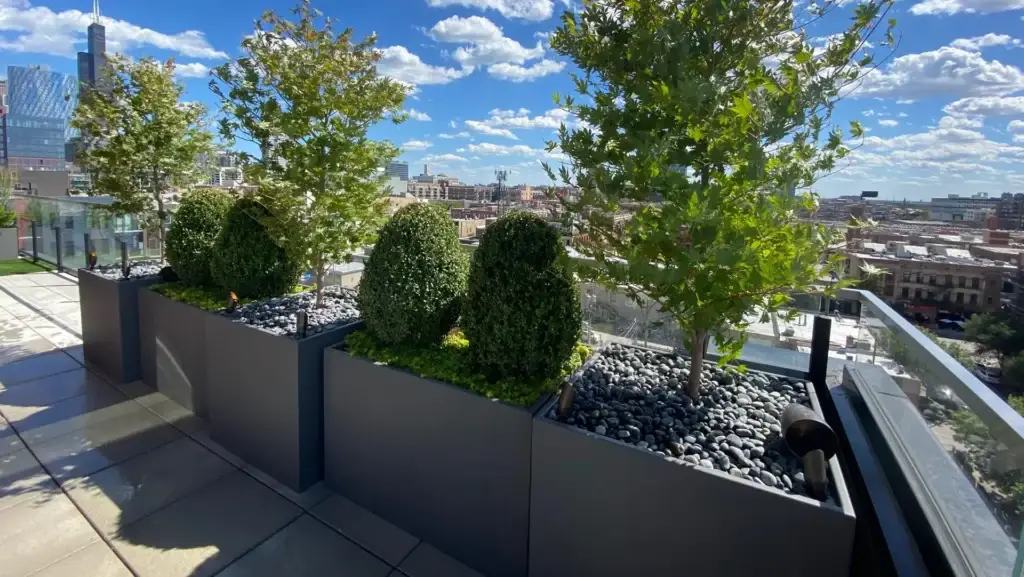
Larger planters typically create a more intentional result. They give roots room to establish, hold moisture more consistently, and read as part of the architecture rather than as accessories. Long rectangular planters are especially effective for defining edges, screening neighboring views, or separating dining and lounge areas.
That said, bigger is not always better. Oversized planters can dominate a compact roof deck, reduce flexibility, and increase weight substantially. The best proportion depends on the deck layout, the desired plant palette, and how the space is meant to function day to day.
Why built-in and custom planters often win
For high-end urban rooftops, built-in or custom-fabricated planters are often the most successful solution. They allow the planter strategy to feel integrated rather than added later. This matters on premium properties where every inch of outdoor space carries value.
Custom planters can be designed to align with decking lines, built-in benches, outdoor kitchens, privacy screens, and lighting plans. They can also solve awkward dimensions that off-the-shelf containers cannot. More importantly, they can be designed around weight distribution, drainage coordination, and maintenance access from the beginning.
This is where a full-service design-build approach makes a meaningful difference. A rooftop is a system, not just a collection of products. When planters are coordinated with construction details, irrigation, and planting design, the finished space feels more refined and performs better over time.
Planting conditions should guide planter choice
The best planters for roof decks depend partly on what will grow in them. Evergreen screening, ornamental grasses, flowering perennials, herbs, and small multi-stem trees each require different root space and moisture conditions.
Privacy planting usually needs more substantial containers than decorative seasonal color. A narrow planter may look elegant, but if it is too shallow for the plant material, it can lead to poor health and frequent replacement. Likewise, a rooftop herb garden may perform beautifully in smaller, accessible planters near a grill or dining area.
Sun exposure also changes everything. A south- or west-facing roof deck can be intense in summer, especially with reflected heat from surrounding surfaces. In those locations, planter depth and irrigation become even more important. On more shaded rooftops, drainage and plant selection may drive the design in a different direction.
Practical details that protect the investment
The most beautiful planter on a roof deck still needs the basics handled correctly. Feet or risers can help with drainage and surface protection. Proper liners and drainage layers support root health. Irrigation often makes the difference between a rooftop garden that thrives and one that becomes difficult to maintain.
Access should also be considered before anything is ordered. If a large planter cannot be moved through the building, up the stair, or into the elevator, the design has to adapt. This sounds obvious, but it is one of the most common rooftop planning issues.
Maintenance deserves an honest conversation too. Some clients want lush, seasonal change and are happy to support ongoing care. Others want a more evergreen, low-intervention look. Neither approach is better, but the planter system should match the expectation.
A design-forward approach always looks better
The most successful roof decks do not rely on random planter placement. They use planters to frame views, guide circulation, soften hard edges, and create a sense of enclosure without feeling boxed in. This is what turns a rooftop into a usable outdoor environment instead of a furnished platform.
For many Chicago properties, that means thinking beyond single pots and considering a layered planter composition. A privacy edge along one side, lower accent planting near seating, and focal containers at entry points can make the entire deck feel composed and intentional. Botanical Concepts Chicago often sees the strongest results when planter design is treated as part of the architecture, not as the finishing touch after construction.
If you are choosing planters for a roof deck, start with structure, exposure, and function before style alone. The best result is rarely the trendiest pot or the cheapest option. It is the planter system that fits the rooftop, supports the plantings, and makes the space feel effortless every time you step outside. That is where rooftop design starts to feel exceptional.